Know your rights
Clear, simple information about your rights at work.
 Bonakala — isiZulu for "to appear, to become visible."
BONAKALA
Bonakala — isiZulu for "to appear, to become visible."
BONAKALA
Bonakala is building an ecosystem for fair employment — connecting people with the knowledge, rights, tools and support they need to navigate working life with greater clarity and dignity.
↓ See how the whole project fits togetherWhatever stage you're at — starting a job, in the middle of one, or sorting out what went wrong — this is what Bonakala actually helps you do.
Clear, simple information about your rights at work.
Keep a secure record of employment & payments.
Collect evidence and understand your options.
Connect to trusted people and organisations.
Build fairer workplaces and stronger communities.
Build a clearer picture of employment and the systems around it.
Bonakala starts from a simple observation: employment can be difficult to prove, understand and navigate when the information is scattered across messages, payslips, verbal agreements, documents and memories. The project is designed to give people a clearer place to build their own record, understand what applies to them and know where to turn when they need support.
Bonakala comes from isiZulu. The verb -bonakala can mean to appear, to be visible, to be clear or evident. That idea sits at the centre of the project: work, rights, evidence and options should not disappear into uncertainty simply because they are difficult to see or understand.
Employment is more than a job title. Bonakala brings together the details, documents, payments, events and evidence that can form a person's working record.
Rights are only useful when people can understand what they mean in their own situation. Bonakala is built around clear information rather than legal language for its own sake.
When something goes wrong, the goal is not to tell someone what decision to make. It is to help them understand the situation, preserve what matters and find appropriate human support.

Hi, I'm Jakobo. I'm 21, I'm not a developer by trade, and I built Bonakala anyway — because some things bother you enough that "not my job" stops being a good enough reason to look away.
What got to me was never one big, dramatic story. It was lots of small, quiet ones: someone not knowing what they were owed, someone too nervous to ask, someone just assuming that's how it goes. None of them were shocking enough to make headlines. All of them stayed with me.
Somewhere in there I landed on an idea I still believe: fairness at work is a compromise, not a fight. Treating someone properly doesn't cost the employer their authority, and being treated properly isn't something a worker should have to feel grateful for — not lucky, not grateful, just equal. I didn't invent that idea. I just couldn't let it go.
So I taught myself to build, over a lot of evenings that were meant for something else, and Bonakala is what came out of it. It's not perfect, and it's just me behind it — no team, no investors, no grand plan. But if it makes even one employment relationship a little fairer, a little kinder — that's already more than I hoped for when I started.
Bonakala Worker gives workers one place to keep track of the working relationships that matter to them. A worker can manage multiple employments at the same time, create and update each employment separately, keep the relevant dates and details together, and build a usable record over time.
Create, manage and track more than one employment independently, rather than forcing a worker's whole working life into a single record.
Keep relevant documents, records and evidence connected to the employment they belong to, so important information is easier to find when it matters.
Surface relevant rights information, practical next steps and support routes without turning a difficult employment situation into a search for scattered information.
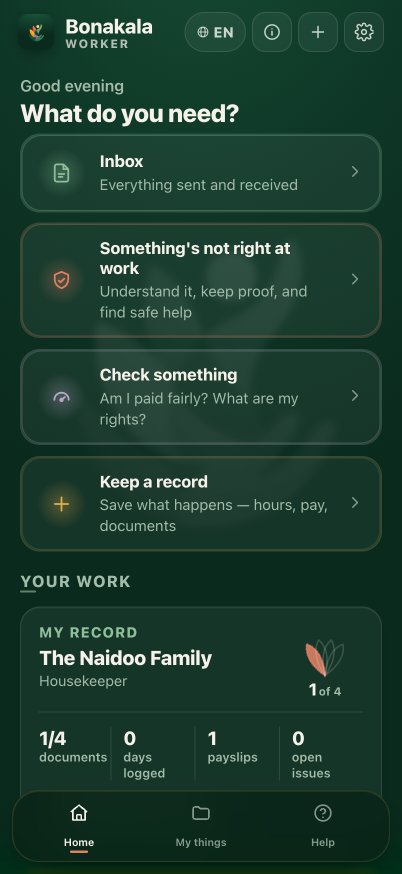
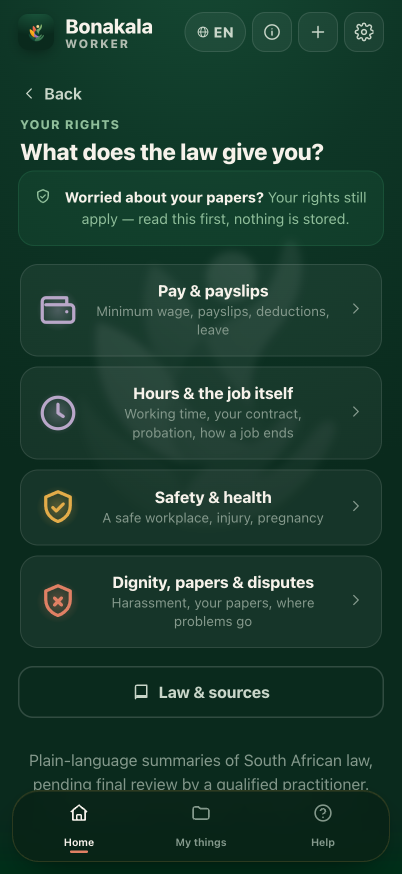
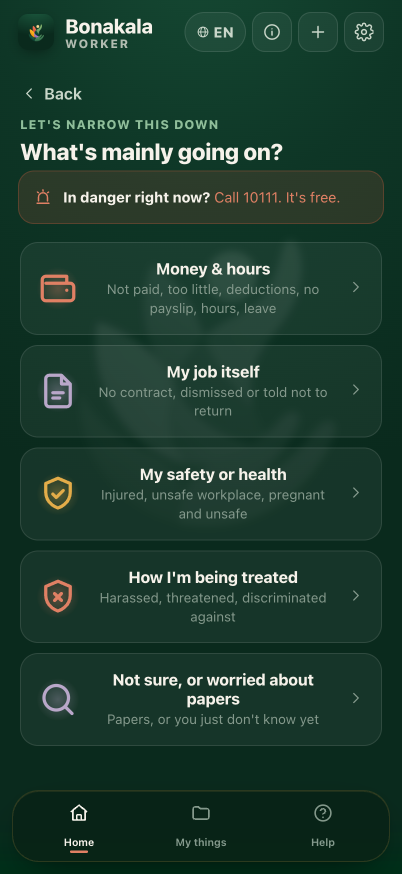
 Bonakala Worker
Set up each employment and keep its core details, documents and history together.
Use structured information to understand the employment situation and relevant rights.
Organise records before a problem becomes urgent, rather than trying to reconstruct events afterwards.
Move from information to appropriate organisations, services or people when support is needed.
Bonakala Worker is available right now through Apple's official TestFlight beta — completely free, no waiting list. Testing it and sharing feedback directly shapes what ships next. The App Store version is already built and on its way; when it goes live, everything already saved in TestFlight carries over automatically, so nothing is ever lost in the switch.
Bonakala Employer helps households employ domestic and household staff the right way — with proper contracts, accurate payslips, and full visibility into what the law actually requires. An employer can manage a whole household team in one place, generate BCEA-compliant documents in minutes, and see exactly what's outstanding and why it matters.
Generate a BCEA-compliant contract in minutes, then payslips with UIF worked out automatically every pay period — no spreadsheet, no guesswork.
See the whole household team at a glance — contracts signed, pay reviews due, UIF and COIDA registration — with plain-language reasons, not just red flags.
Pair securely with your employee's own Bonakala Worker app to send contracts, payslips and letters the moment they're ready — no printing, no lost paperwork.
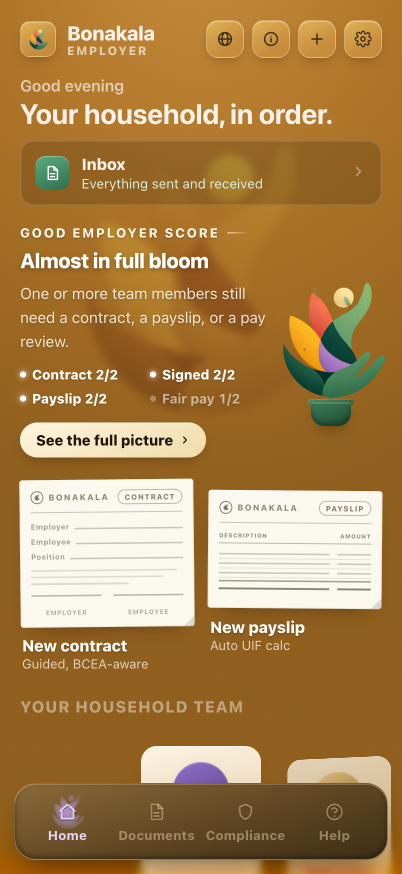
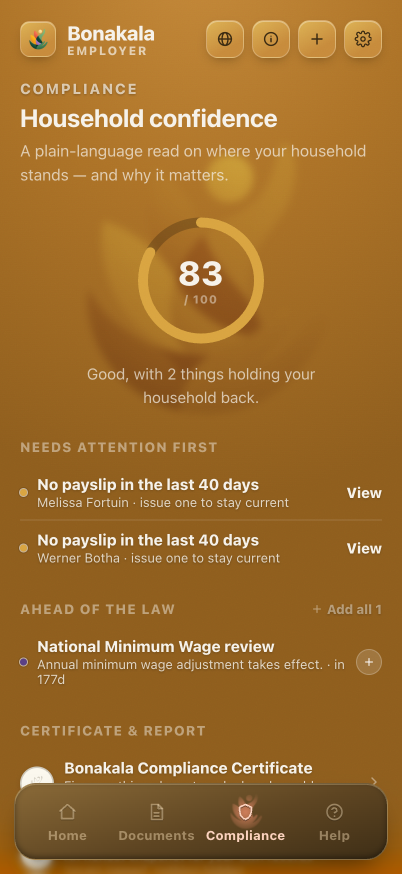
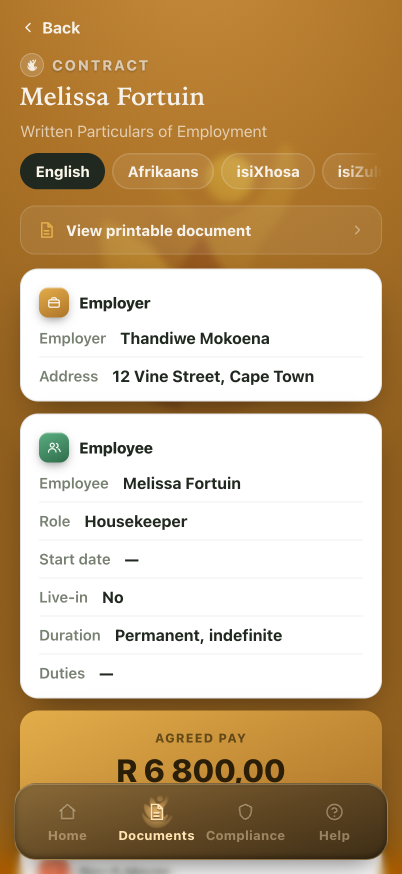
 Bonakala Employer
Bonakala Employer runs as a full desktop web app too — the exact same account, kept automatically in sync with your phone. It's the easier way to set up contracts, review the whole household's compliance, and get real paperwork done at a desk.
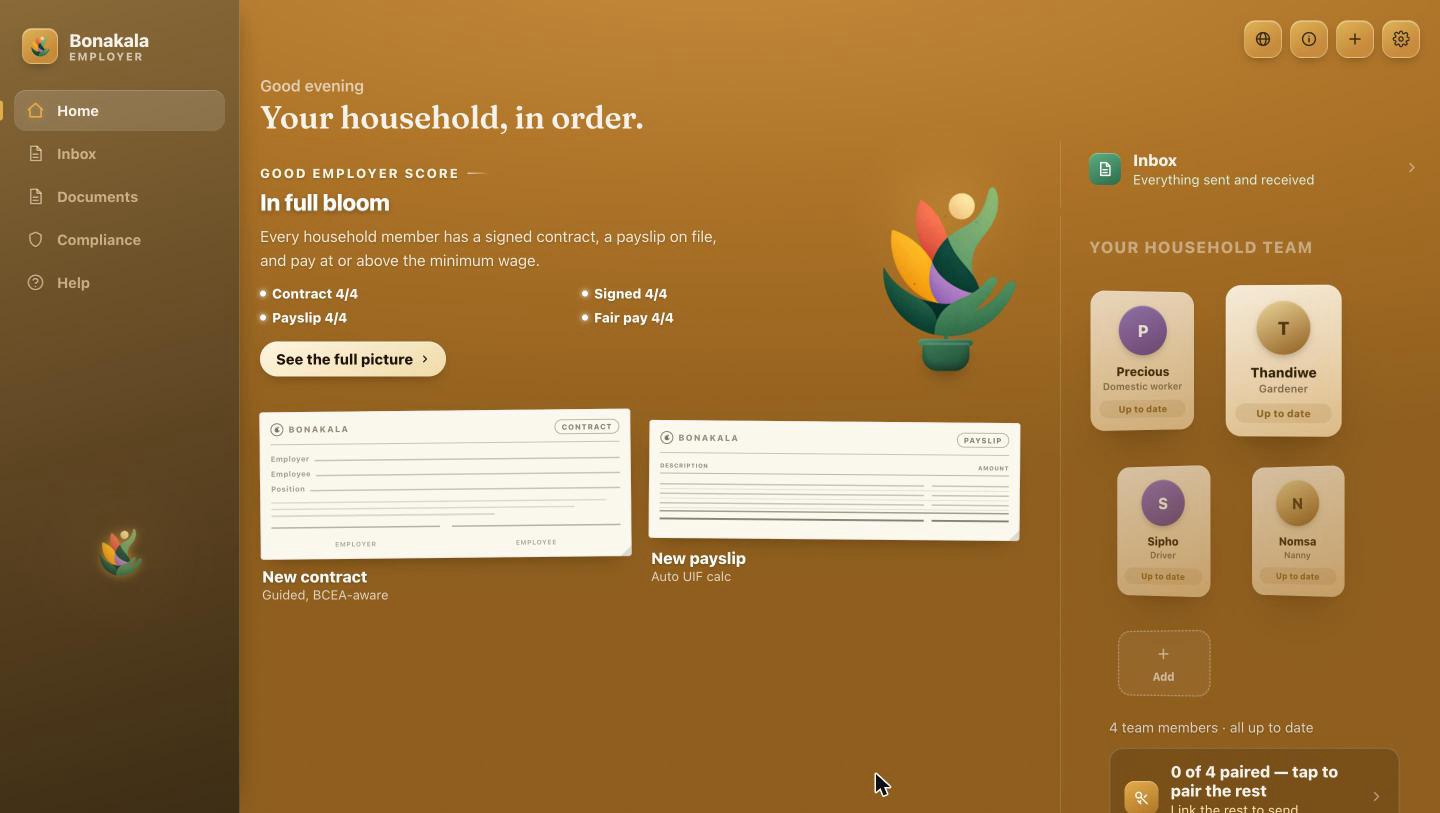
Add each employee and generate a guided, BCEA-aware contract in minutes.
Generate a payslip each period with UIF calculated automatically.
See what's outstanding across the whole household team before it becomes a problem.
Send documents straight to your employee's own Bonakala Worker app the moment they're ready.
Bonakala Employer is now live on the App Store — completely free, no waiting list, no TestFlight sign-up required. Download it directly and start building proper contracts and payslips right away.
Bonakala is designed around the idea that information is only useful when a person can act on it. The Worker experience therefore connects rights information and practical guidance with routes to real-world support.
Relevant government and public-service information can be brought closer to the employment record, so workers do not have to start from zero when looking for authoritative guidance.
Bonakala can point people towards organisations that provide practical assistance, worker support and community-based services.
Where a situation calls for specialised help, the goal is to make relevant legal, labour and worker-support pathways easier to identify.
The important step is not simply knowing that a right exists, but understanding what can be done next and where appropriate human support can be found.
Bonakala is built around clarity, agency, evidence, privacy, accessibility and connection to real human support.
Rights. Fairness. Dignity.
Bonakala — isiZulu for "to appear, to become visible."
Site owner: Jakobo-Maria Bartusch · Contact: bonakala@tutamail.com